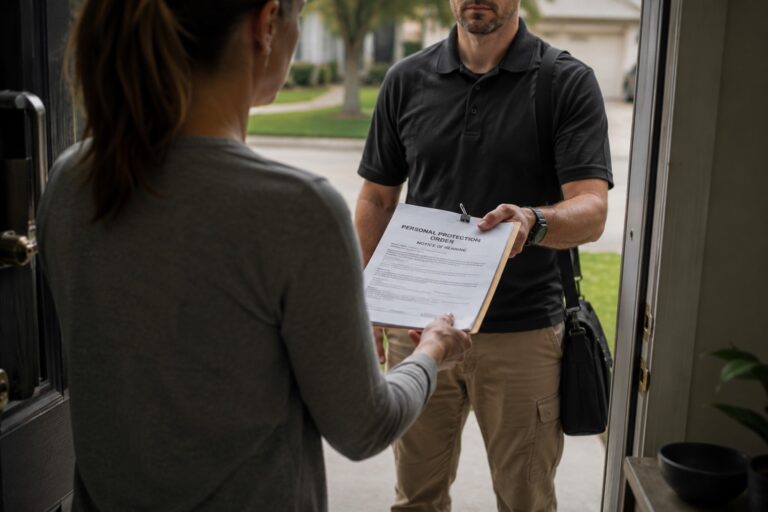


What Is a No-Contact Order After a Domestic Violence Arrest?
A no-contact order is a condition the court places on your release when it sets bond, usually at the arraignment. It is authorized under Michigan law, MCL 765.6b, which lets the court protect the alleged victim as a condition of your bond.
The order tells you to stay away from the protected person while your case is pending. It is not a finding that you are guilty of anything, and it is not permanent, but it takes effect immediately and you are expected to follow it to the letter.
Because it is part of your bond, it applies from the moment you are released until the court says otherwise. We explain the broader picture of your case on our domestic violence defense page.
What Exactly Does a Bond No-Contact Order Forbid?
It forbids all contact with the protected person, and “all” is meant literally. That means no direct contact, no indirect contact, and no contact passed through third parties such as friends, family, or social media.
It does not matter who starts the contact. If the protected person calls you, texts you, shows up, or invites you over, the order still binds you, and answering can still be a violation.
That last point traps a lot of people. A no-contact order restricts your conduct, not theirs, so an invitation from the other person is never permission to respond.
What Other Bond Conditions Are Common in These Cases?
A no-contact order rarely travels alone. Alongside it, Michigan courts commonly order that you not possess or purchase a firearm or other weapon while the case is pending.
Courts also frequently prohibit alcohol and drugs, often paired with testing to confirm you are complying. In some cases the court orders GPS or electronic monitoring, and when monitoring is ordered, a no-firearm condition is required as well.
Each of these is a separate promise you make to the court in exchange for release. Our criminal defense page walks through how these conditions fit into the case as a whole.
How Is a Bond No-Contact Order Different From a PPO?
The two get confused constantly, but they come from different places. A personal protection order, or PPO, is a civil order that the other person asks a court to issue against you.
A bond no-contact order is different: it is a condition of your release inside the criminal case, ordered by the judge as part of your bond rather than requested by the other person. You can be subject to one, the other, or both at the same time.
Because they are separate orders, they have to be handled separately, and lifting one does not lift the other. You can read more about the civil side on our personal protection orders page.
Facing a domestic violence charge and a no-contact order in Wayne County? Tell William Hackett what happened and he will get back to you.
Request a Confidential Consultation
What Happens If You Violate the No-Contact Order?
Violating a bond no-contact order carries two distinct risks, and either one is serious. First, the court can revoke your bond, which means you go back to jail while the underlying case continues.
Second, the violation can bring a new charge, entirely separate from the domestic violence case you already have. You can end up defending two matters at once instead of one.
The order can also be entered into the Law Enforcement Information Network, known as LEIN, so any officer who runs it can see it. Police can make a warrantless arrest on reasonable cause that the order was violated, which means an officer does not need a warrant to take you in.
Which Court Sets Your Bond and Its Conditions?
Your bond and its no-contact condition are set at the domestic violence arraignment in the district court for the city where the case arose. Knowing that court helps you know where any request to change the order has to go.
If your case is in Taylor, the arraignment and bond are handled at the 23rd District Court. If the case arose in another Downriver community, it is heard in that city’s district court instead.
Local practice varies from one courthouse to the next, which is one reason a lawyer who appears in these courts regularly can be valuable early. Our attorney page explains that Downriver background.
Can a No-Contact Order Be Changed or Lifted?
Yes, but only the court can change it, and only through the proper request. If the two people genuinely want contact restored, the correct route is to ask the court to modify the bond condition.
The one thing you must not do is contact the person directly to sort it out yourselves. Reaching out on your own is exactly the violation the order forbids, no matter how amicable the reason.
A defense lawyer can file to modify or lift the condition and present the request to the judge the right way. Whether the court agrees depends on the facts, and no outcome is guaranteed, but the request has to go through the court to count.
How Does an Attorney Help With Bond and No-Contact Issues?
An attorney works both the conditions and the case itself. On the conditions, a lawyer can argue at arraignment for reasonable terms, and later ask the court to modify a condition that is causing real hardship, such as shared children or a shared home.
On the case, the same attention to the facts that shapes the defense can affect how the bond issues resolve. We cover whether a case can be resolved short of trial in Can Domestic Violence Charges Be Dropped in Michigan? and how release works in How Bond and Bail Work in Michigan.
Every case is different, and the right approach depends on your specific facts. The sooner the case is reviewed, the more can be done about both the charge and the conditions you are living under.
This article is general information about Michigan law and is not legal advice. Reading it does not create an attorney-client relationship. For advice about your specific situation, speak with a licensed Michigan attorney.