
What Does Michigan’s Open Intoxicants Law Prohibit?
MCL 257.624a makes it unlawful for an operator or an occupant to transport or possess alcoholic liquor in a container that is open, uncapped, or on which the seal is broken, within the passenger area of a vehicle.
Where that applies is broader than a moving car on a highway. The section reaches a vehicle on a highway, and a moving vehicle in any place open to the general public or generally accessible to motor vehicles, including a parking area.
Note the word “occupant.” This is not a driver-only offense, which surprises passengers who assumed the container in their own hand was the driver’s problem or nobody’s.
There is also no requirement that anybody was drinking, or that the driver was impaired. Transporting or possessing the open container within the passenger area is the conduct the statute describes.
Is the Trunk an Exception?
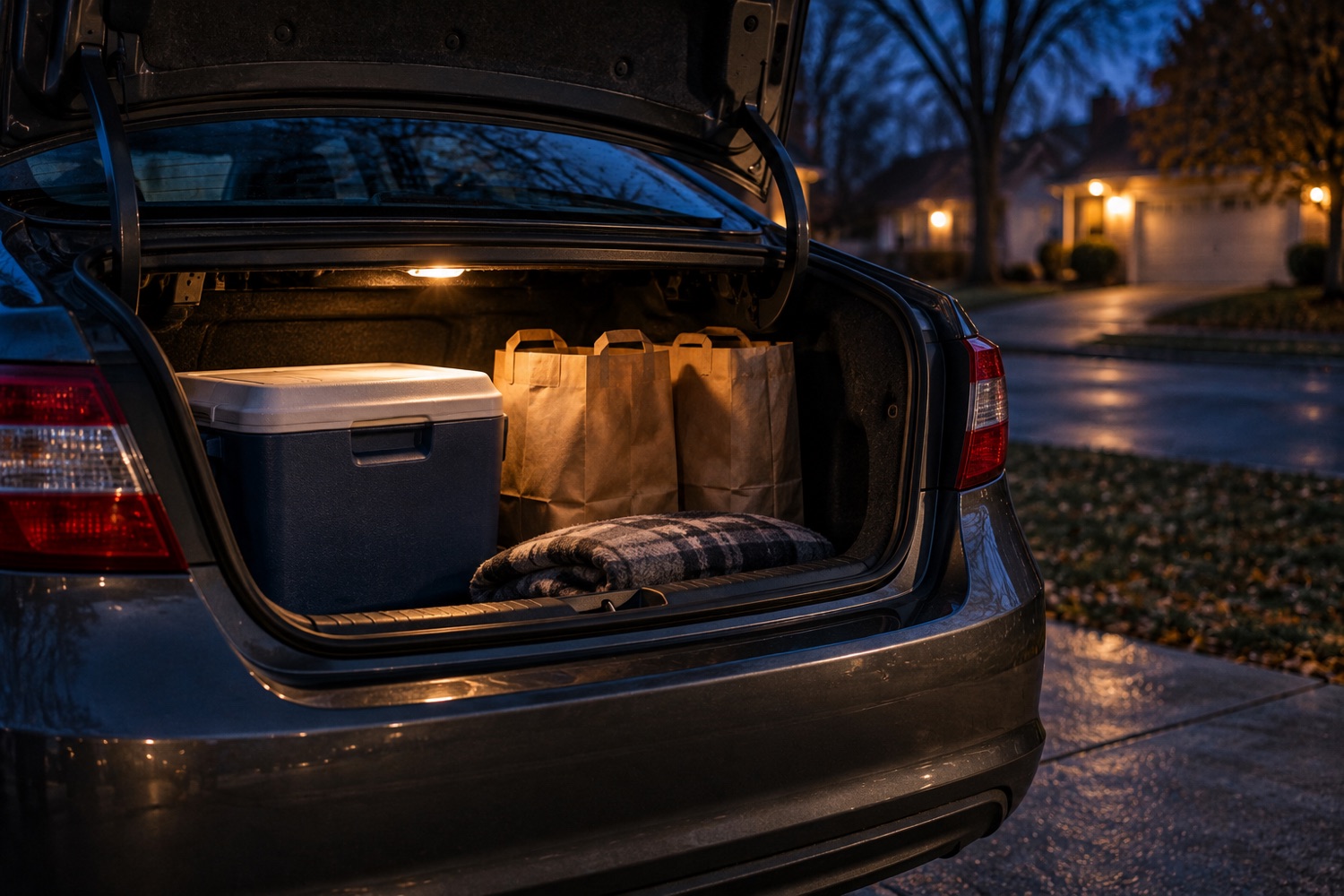
The trunk is not an exception because it is not covered in the first place. The prohibition attaches to the passenger area, so a sealed or unsealed container in a closed trunk sits outside what the section describes.
What confuses people is subsection (2), which does read like an exception list. It allows transporting an open container in a locked glove compartment, behind the last upright seat, or in an area not normally occupied by the operator or a passenger.
Read the opening words of that subsection. It applies only “if the vehicle does not have a trunk or compartment separate from the passenger area.”
That is why hatchbacks, SUVs, and pickups are where these charges cluster. A sedan driver puts the bottle in the trunk and the question ends. A hatchback driver has no trunk, so subsection (2) is the only route available, and the cargo area behind the last upright seat is what it points to.
What Counts as the Passenger Area?
The statute defines it, and the definition is wider than the seats. Under MCL 257.624a(6)(b), the passenger area is the area designed to seat the operator and passengers while the vehicle is in operation, and any area readily accessible to the operator or a passenger from a seating position.
The same subsection then names one area specifically: the glove compartment is part of the passenger area.
That single line undoes a common assumption. Moving a bottle from a cupholder to the glove box is a move within the passenger area, not out of it.
Subsection (2) does list a locked glove compartment, but only for a vehicle with no trunk, and only a locked one. MCL 257.624a(6)(a) defines a glove compartment as a recess with a hinged and locking door in the dashboard, so an ordinary latch that does not lock is not what the statute describes.
What Is the Penalty for Open Intoxicants in Michigan?
A violation is a misdemeanor under MCL 257.624a(3). The section does not set out days or dollars, which sends the question to the Michigan Vehicle Code’s general penalty provision.
MCL 257.901 supplies them: unless another penalty is provided, a misdemeanor under the code is punishable by a fine of not more than $100, or imprisonment for not more than 90 days, or both.
That is worth stating plainly, because the reflexive figure for a Michigan misdemeanor is 93 days and $500, and it is not the figure here.
The sentence can carry more than the fine. As part of it, the court may order community service and substance abuse screening and assessment at the person’s own expense.
There is also a licensing consequence people do not anticipate. A violation of section 624a carries 2 points under MCL 257.320a, which is the same 2 points most other moving violations carry, and those points accumulate exactly as described in our guide to how many points suspend your license in Michigan.
Charged with open intoxicants after a traffic stop? Tell William Hackett what happened.
Request a Confidential Consultation
Does It Apply to Passengers and to Parked Cars?
Passengers are covered. The prohibition names an operator or an occupant, so a passenger holding an open container in the passenger area is within the section regardless of who is driving.
Parking lots are covered too, in the terms the statute uses. It reaches a moving vehicle in any place open to the general public or generally accessible to motor vehicles, including an area designated for parking.
There are two express carve-outs. Subsection (4) exempts a passenger in a chartered vehicle authorized to operate by the state transportation department, and subsection (5) exempts a passenger in a commercial quadricycle, the pedal-powered party bikes, unless a local ordinance prohibits it. Even then, that passenger may carry only beer, wine, spirits, or a mixed spirits drink.
How Does This Interact With a Drunk Driving Stop?
Open intoxicants often arrives as a second charge alongside a drunk driving case, and it is a separate statute with separate elements. An impaired driving charge is governed by MCL 257.625, and the differences among those charges are covered in OWI vs. OWVI vs. OWPD.
One procedural rule in the open intoxicants statute is easy to miss. MCL 257.624a(3) provides that a court shall not accept a plea of guilty or nolo contendere to this section from a person charged solely with a violation of section 625(6), which is Michigan’s zero tolerance provision for drivers under 21.
For a driver under 21, that provision sits next to the alcohol offenses covered in minor in possession in Michigan, and the two are frequently charged out of the same traffic stop.
If the stop also produced a breath result at or above 0.17, the enhanced charge described in Michigan’s Super Drunk law changes the shape of the case entirely.
Which Courts Hear These Cases?
An open intoxicants charge is a misdemeanor, so it stays in the district court for the community where the stop happened.
Downriver that is the 23rd District Court in Taylor at 23365 Goddard Road, the 25th in Lincoln Park, the 27th in Wyandotte, or the 33rd in Woodhaven. Farther west, the 34th District Court in Romulus, the 16th in Livonia, and the 18th in Westland handle their own communities.
What to Do If You Are Charged
The facts that matter are small and specific: where the container was, whether the vehicle has a trunk, whether the glove compartment locks, and whether the vehicle was on a highway or in a place the statute describes.
Those details fade quickly, and they are the difference between conduct the statute covers and conduct it does not.
William Hackett handles alcohol-related and drunk driving defense cases throughout Wayne County and Oakland County, including OWI matters in Taylor and the broader criminal defense work that comes with them. His background is on the attorney page, and the contact page reaches the Taylor office directly.
This article is general information about Michigan law and is not legal advice. Reading it does not create an attorney-client relationship. For advice about your specific situation, speak with a licensed Michigan attorney.